Saturday, February 12, 2011
Good balance
requires a strong ability to relax when we are off balance. One of the worst things we can do when we feel off balance is to tense our muscles. If we try to stop ourselves from moving or swaying, we will only become more off balance.

Saturday, February 5, 2011
I fell three
times yesterday while running outside (I was not being chased. I like to run for many reasons). Ice had covered the snow and was impossible to break through for traction. My falls made me think about what my clients who fall must feel like.
Falling is so much more common during times when precipitation occurs. Ice is a huge cause of falls. Black ice is even worse. As tempting as it is to walk onto ice (to go get the mail, shovel the drive way, walk the dog, etc), it should be avoided at all causes.
Ice is not the only type of precipitation that makes us much more likely to fall. When surfaces become wet they can sometimes be very similar to ice. Wet grass, tile, linoleum, wood and blacktop can all make a person much more likely to fall.
Inclines or uneven surfaces that become wet or icy increase the risk of falling exponentially.
Tuesday, February 1, 2011
The Dizzy Pie
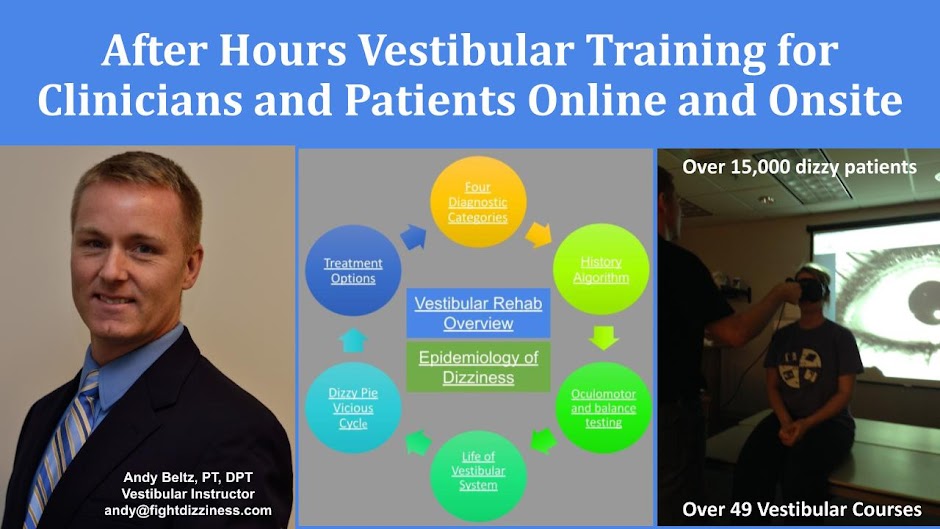
Many times, my clients are not dizzy for one reason alone. Many have multifactoral dizziness. As a result, I find myself picturing my client's problem with dizziness like a big pie with each piece representing one of the reasons for their dizziness. For instance, 1/5th of the dizzy pie may be an inner ear weakness, 1/5th may be from disuse dysequilibrium, 2/5ths may be from benign paroxysmal positional vertigo and 1/5th may be from visual dependence.
Saturday, January 29, 2011
Vestibular testing
sometimes needs to be performed over time. If a person is not in the midst of a spell when having their vestibular system checked, the result of the test may not always be accurate. The key to receiving an accurate picture of how well the inner ear is truly working is to test how well it functions on "good" and "bad" days.
Thursday, January 27, 2011
Lateral canal cupulolithiasis with vibration
I recently had a client who had ageotropic nystagmus in the head right position that did not fatigue at 3 minutes. It did abate with fixation, but returned when the fixation light was turned off. After about 20 seconds of vibration, the ageotropic nystagmus abated. Upon rolling to her left side she had geotropic nystagmus. Following 2 360 degree rolls, she no longer had nystagmus in either of the positions. We finished with one more 270 roll.
Sunday, January 23, 2011
What does dizzy mean?
According to the clients I have seen, there are at least 114 ways to describe the sensation. One of the keys to getting help when an individual is dizzy is for them to be able to describe the different sensations they feel when they are dizzy. Learning the "dizzy language" helps battle the problem.
Friday, January 21, 2011
"He'll snap your head back and forth"
WAIT!!! STOP!!!! No I won't. A client recently told me she was told I would do this to her to help get rid of her dizziness. I guess it was part of the motivational talk she received to build up the courage to come and see me for vestibular rehabilitation.
It's funny how we describe experiences. In my opinion, this language does not represent the type of therapy I do. Perhaps it is just a matter of semantics. I don't "snap" heads. In fact, 99% of the things I do are very gentle. I think a better way to say it is "he'll turn your head gently in proper directions at the right time."
It's funny how we describe experiences. In my opinion, this language does not represent the type of therapy I do. Perhaps it is just a matter of semantics. I don't "snap" heads. In fact, 99% of the things I do are very gentle. I think a better way to say it is "he'll turn your head gently in proper directions at the right time."
Subscribe to:
Posts (Atom)